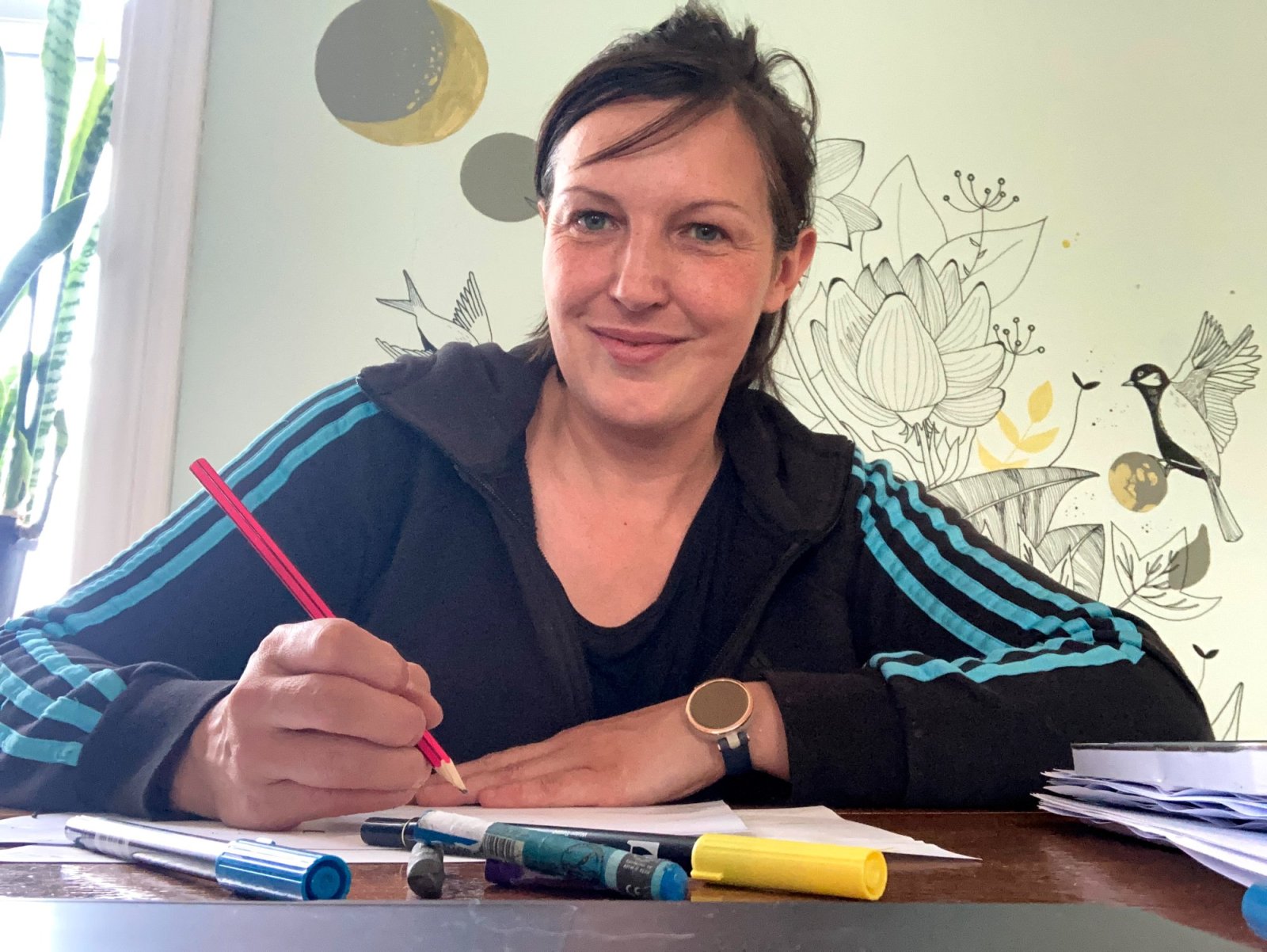
French illustrator Élise Plessis, based in northern Iceland, is the artist behind the distinctive, colourful world of the Oniverse, a series of imaginative board and card games created by game designer Shadi Torbey. Beginning with Onirim in 2010, the series has grown into nine games, each exploring a different part of the same dreamlike universe. Designed primarily for solo play, with cooperative options, the games take players through mysterious labyrinths, fantastical cities, underwater worlds and beyond.
For more than fifteen years, Élise and Shadi have shaped this universe together, with her illustrations sometimes inspiring new ideas for the games themselves. In this interview, Élise reflects on their creative partnership, the evolution of her artwork, her love of traditional drawing materials and the artistic possibilities she hopes to explore next.
When Shadi first asked you to illustrate Onirim, neither of you could have known that you would still be shaping this world together more than fifteen years later. How did your role in the Oniverse evolve from illustrating that first game to helping shape the world alongside Shadi?
I think that creative exchange was there from the start. We didn’t have a publisher when I met Shadi, and it was just the two of us when he introduced me to the prototype of Onirim. I always felt I had a lot of freedom in designing the images of the Oniverse, and I enjoyed that a lot.
I would indeed have been incredibly surprised and thrilled if someone had told me in 2010 that the Oniverse would eventually count nine games. The Oniverse stepped out of the labyrinth and expanded in many directions. It was amazing to discover that it was bigger than I had realised and that I would get to draw and explore it.
When Shadi gives me the setup for a new game, I always start wondering and dreaming: What does the Oniverse look like in space? In the sea? What is its factory like? I start making sketches depending on the material we need, keeping in mind the connection with all the other games. The Oniverse has grown richer and more detailed, but all the games are still, in some way, related to the original labyrinth.
"Inspiration comes from living one’s life. From going out and seeing what’s out there."
You have described moments when something you drew gave Shadi a new idea for the game, which then led to new artwork and sometimes further ideas. What has that creative loop taught you about what can happen when game design and illustration are allowed to influence each other?
It taught me that we can achieve more by putting our strengths and minds together. I don’t believe in locking oneself in a room and waiting for inspiration to arrive. Inspiration comes from living one’s life. From going out and seeing what’s out there. From being challenged by someone else’s ideas and personality.
The cooperation between Shadi and me is quite unusual, as game designers and artists don’t normally work directly together but are coordinated by a publisher (though Shadi now also plays this role within inPatience). Our teamwork has always been fruitful, and we have both brought our complementary skills to the Oniverse.
After so many different places, creatures and ideas have entered the Oniverse, how do you know when something truly belongs there? Are there rules behind its visual identity that you consciously protect, or has that coherence become something you simply feel?
That’s a subject Shadi and I have discussed several times over the years. What is the Oniverse, and what belongs in it? When I start sketching, I don’t put any restrictions or limits on what I draw. I just allow myself to dream and put my thoughts on paper, and that would probably be my criterion: if it makes me dream, it belongs to the Oniverse.
Shadi then takes a fresh look at the images I’ve made and sees which ones are the best fit. I sometimes get carried away by the many ideas crossing my mind, and I remember him telling me a few times: “This is too crazy, even for the Oniverse.” I can sometimes go too far, but that is all right, as I know that Shadi is always there to keep things on track.
You recently returned to Urbion and created new artwork for a world you had first explored more than a decade earlier. What was it like to meet your own earlier work again, and how do you allow yourself to evolve without erasing what gave the original its character?
When I revisited the work I had done for Urbion more than ten years earlier, I had to make a list of what I thought was satisfying and consistent with the nature of the Oniverse, and what I thought could be improved without changing its original character. I can be quite hard on myself when I look at my previous work, and I was very critical of it.
In the new version, I tried to give the images more detail and impact. I felt that some of the old ones needed to be drawn with more clarity. But I still liked the characters and kept most of them untouched. I used to be very impulsive when drawing. My experience has led me to balance my enthusiasm with greater precision, making the images less rough and more defined.
You also create illustrations outside board games. What feels fundamentally different when you are creating artwork for a game — something people will handle, navigate and return to repeatedly — rather than an image that mainly stands on its own?
Drawing a board game is a little like drawing a story. There needs to be consistency in shapes and colours. All the elements need to match to create a harmonious ensemble when everything is laid out together on a table. The tokens will be placed on the boards: how do they fit together? Everything has to look good independently and with the rest of the material.
Another distinctive aspect of illustrating board games is that some of the elements are rather small. Even though it is nice to add details that players might only notice on their third or fourth playthrough, the images need to have an impact and remain effective at the small size of the components.
In 2017, you said that board game art often felt too conservative and uniform. Almost a decade later, do you still feel that way? Where do you think board games have become visually more adventurous, and where would you still like to see artists take more risks?
No, I feel the board game scene has changed tremendously in a short period of time. The creativity shown nowadays is utterly fascinating. Artists use all kinds of styles and techniques, and the games coming out now are more beautiful than ever.
From the origami illustrations in Sea Salt & Paper to the national park posters used in PARKS, it seems there are now illustrations to please an ever-growing audience. I think publishers should keep on taking more risks by hiring unconventional artists who will continue to make games visually interesting.
Your work remains very physical and tactile: paint, pencils, ink and paper. What does working with real materials bring to an image that you would never want to lose in the finished artwork?
Working with tactile materials conveys, first of all, the pleasure I take in drawing and my involvement in the process. I need to be in contact with those materials to “feel” the image.
Working with these materials also brings a lack of control: watercolour paint and ink can run in unexpected ways, pencils can smudge, and I like to be surprised. This creates images that are less polished and feel more lively. I want players to feel the brushstrokes and the texture of the paper on the playing cards.
“I want players to feel the brushstrokes and the texture of the paper on the playing cards.”
“I think I let the pleasure of drawing take control.”
The Oniverse has a very recognisable atmosphere of its own. When you create an image, how consciously do you think about the feeling you want it to evoke in the player — and how much do you simply trust your own visual instinct?
I know the general feeling I want to evoke through a game before I start working: curiosity, surprise and dreamlike thoughts. But once I start drawing, I totally forget about it, and my instincts take over. I think I let the pleasure of drawing take control. I sometimes get results I didn’t expect, but I think the original intention is always there in the end.
With Ultimion bringing the Oniverse in its familiar form toward a conclusion, what do you hope players will ultimately remember about the world you and Shadi created together — and after spending so many years inside it, what kind of visual territory are you curious to explore next?
I hope people will remember the fun they had playing the games. That they enjoyed a break from reality, travelling through this bizarre and colourful world. The Oniverse is a solo board game series that was first published at a time when solo board games were not so common, and I think it was quite bold of Shadi to have started it. I think the games are very well structured and, at the same time, very inventive, and I am proud to have illustrated them.
I would be thrilled to explore different visual techniques next. Paper collage, photographs of 3D sculptures or something very graphic. Or why not some abstract illustration? I love to experiment, and while it is good to stick with one recognisable style, it is also a lot of fun to try something new and challenge oneself…
No comments yet. Be the first to share your thoughts.